
SpaceX has built one of the strongest proof systems in modern business. It made private launch credible, turned rocket reuse into operating discipline, scaled Starlink into a global communications network, and made public failure part of the rhythm of engineering progress.
Reuters reported in April 2026 that SpaceX’s IPO filing targets a $1.75 trillion valuation and a $75 billion raise, with Elon Musk and insiders retaining control through super-voting shares. Reuters also reported that the combined SpaceX/xAI company recorded a $4.94 billion loss on $18.67 billion revenue in 2025, while Starlink generated $4.42 billion in operating profit and AI infrastructure spending drove heavy cash burn. Reuters reported the IPO structure and 2025 financial figures.
SpaceX’s value comes from Breaker behaviour made real through operational proof. Its risk comes from that same behaviour operating at the scale of public markets, public infrastructure, defence dependency, AI infrastructure and human spaceflight.
Can SpaceX keep Activation Load and Interpretive Capacity in proportion as it moves from challenger to infrastructure institution?
Origin and inheritance
SpaceX began as a private challenge to a launch system shaped by state agencies, large defence contractors, high cost, long cycles and institutional caution. Its authority was earned through proof: orbital achievement, reusable launch, NASA partnership, national-security work and visible cadence.
NASA remains central to that legitimacy. Its Commercial Crew Program presents private industry partnership as a route to safe, reliable and cost-effective transport to and from the International Space Station. That gives SpaceX an institutional register that its owned channels rarely provide by themselves. NASA’s Commercial Crew Program gives the partnership its public-service grammar.
SpaceX’s inheritance is split. It carries the emotional logic of a challenger and the operational consequences of a public contractor. That split has become sharper as Starlink, Starship, defence work, AI infrastructure and IPO preparation gather inside one story.
Overall Continuum reading
SpaceX’s visible brand pattern is Expansion + Freedom in the Distinctive zone.
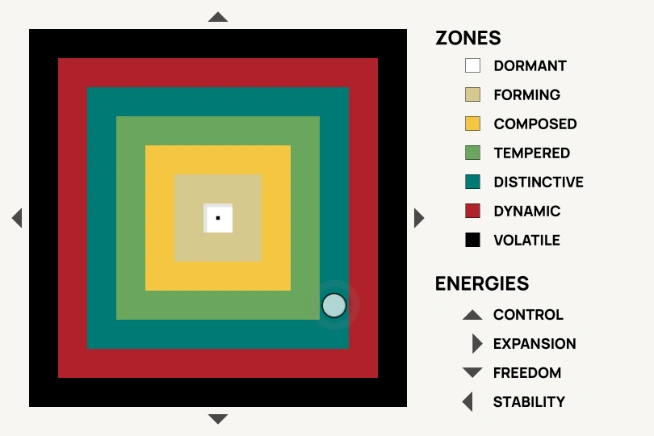
That’s how the brand presents: future, speed, public learning, Mars, Starship, AI infrastructure, launch spectacle, technical daring and visible proof. It stands out. It attracts demand. It moves first and lets others interpret the trail behind it.
Its overall Continuum condition is Dynamic, with a Distinctive proof core.
Falcon gives SpaceX a strong Distinctive proof core. Starlink gives it commercial scale. The wider system is now governed by Dynamic pressure because future value depends on several high-load systems being interpreted at once: Starship, Starlink governance, xAI integration, IPO confidence, NASA obligations, FAA approvals and founder-led communications.
SpaceX expresses as Distinctive. It operates under Dynamic load.
Continuum position by system
Falcon is Distinctive moving towards Tempered. The system has high activation, strong proof and mature correction. Space.com reported 165 Falcon 9 orbital launches in 2025, SpaceX’s sixth consecutive annual launch record. Space.com also reported SpaceX’s 600th successful orbital-class rocket landing in April 2026. Space.com’s 2025 launch record report shows the cadence, while its 600th landing report shows the reuse proof.
Starship is Dynamic with live Volatile oscillation risk. It carries NASA, Mars, Starlink capacity, investor belief, launch-site expansion and symbolic proof at once. NASA’s Office of Inspector General said SpaceX’s lander would miss the June 2027 lunar surface mission need and identified schedule, technical, integration and crew-safety concerns in the Human Landing System programme. NASA OIG’s March 2026 HLS report gives the programme-risk evidence.
Starlink is Distinctive commercially and Dynamic geopolitically. Reuters reported that Starlink had more than 9 million users globally and more than 9,500 satellites deployed since 2019, generating 50 to 80 per cent of SpaceX revenue. That is proof of scale. It also shows that SpaceX has become communications infrastructure, with the public responsibilities that follow. Reuters’ SpaceX business and finances explainer sets out the network’s scale and revenue role.
Communications are Distinctive by spectacle and vulnerable through founder dependency. SpaceX’s visible public system is built around owned channels, launch events, X, product pages and NASA-linked mission communications. That creates attention. It concentrates interpretation.
Proportion problem
SpaceX’s Proportion challenge has changed. The old question concerned whether private spaceflight could work. Falcon and Dragon largely answered that. The current question concerns whether the organisation can remain governable as more public consequence attaches to its behaviour.
Activation Load is rising from several directions at once: IPO preparation, xAI integration, Starlink expansion, Starship testing, NASA HLS obligations, national-security launches, AI infrastructure spending, environmental scrutiny and regulatory approval.
Interpretive Capacity is uneven. Falcon appears mature. Starlink appears commercially strong, with weaker public proof around geopolitical governance. Starship has an active correction loop, but the public obligations attached to it are growing faster than the visible proof. xAI adds a new operating layer whose SpaceX-specific governance is still difficult to read.
Reuters’ April 2026 reporting makes the proportion problem unusually clear. Starlink is producing operating profit, while AI infrastructure spending has created a large new cash demand inside the combined company. Reuters described the pressure between Starlink income and AI spending.
One part of the system generates cash. Another absorbs it. A third carries the myth. A fourth carries public risk.
That is a load pattern, and it now defines the brand condition.
Behavioural read
SpaceX rewards visible progress. Launch, land, relaunch, stream, announce, correct, repeat. It protects cadence. It makes engineering proof public. It makes institutional delay look old, slow and defensive.
That behaviour gives SpaceX its force. It compresses time. It attracts talent. It makes investors believe in future markets before those markets fully exist. It turns operational milestones into communications assets.
The same behaviour creates leakage when speed reaches the edge of public consequence. After earlier Starship failures, the FAA expanded the Aircraft Hazard Area for Flight 9 to about 1,600 nautical miles, compared with about 885 nautical miles for Flight 8. Reuters also reported the expanded keep-out zone, including areas through the Straits of Florida, the Bahamas and Turks and Caicos. Reuters reported the FAA’s return-to-flight approval and expanded hazard area.
SpaceX learns by moving. Public infrastructure asks for visible containment as well as movement.
Proof system
SpaceX has three kinds of proof.
The first is operational proof. Falcon is the core. The cadence, reuse and landing record show that reusability has become an operating model. This is the strongest trust asset in the system.
The second is institutional proof. NASA, the FAA, the U.S. Space Force and other government bodies interpret SpaceX for the market. They supply procurement, audit, mission language, safety review and public legitimacy. Reuters reported that SpaceX received about $5.9 billion for 28 National Security Space Launch Phase 3 missions through 2029. Reuters reported the NSSL Phase 3 award.
The third is symbolic proof. Starship tests, booster catches, livestreams, X posts and Mars language convert engineering risk into public drama. That gives SpaceX attention advantage. It also lets symbolic proof run ahead of operating proof.
The practical split is clear. Falcon is proof. Starlink is proof plus governance exposure. Starship is promise under test. xAI is new load.
Transformation and operating change
SpaceX is now a transformation system as much as a space company.
Starlink moves internet access into satellite infrastructure at global scale. Direct-to-device ambitions push SpaceX towards everyday communications. xAI moves the company into AI infrastructure. The reported IPO puts launch, satellite broadband, defence, AI and future off-Earth infrastructure into one capital-market story.
Reuters reported that SpaceX now presents AI as a major growth market, including space-based data centre ideas, while AI capex accounted for a large share of 2025 spending. Reuters reported SpaceX’s AI growth-market framing.
Investors need to know where Starlink cash ends and AI/Starship funding begins. NASA needs to understand schedule and crew risk. Regulators need hazard, correction and compliance proof. Users and governments need continuity, reliability and access assurance.
Starlink may be used widely, but the question is whether governments, users, investors and regulators understand how it fails, who can correct it, and what happens when access becomes politically sensitive.
Energy and Expression
SpaceX’s dominant Energy is Expansion. Its main Expressions are Visionary and Breaker.
Visionary gives the company the future: Mars, Starship, lunar logistics, global satellite communications, AI infrastructure. Breaker gives it the method: challenge the cost structure, challenge the incumbent cadence, challenge procurement rhythm, challenge what a private company can do.
Freedom is the secondary Energy. It appears through Mover and Liberator behaviour: move quickly, stream the test, publish the ambition, return quickly after failure, bypass conventional media patterns where possible.
Control exists inside the engineering system. Falcon shows Ruler and Navigator behaviour in mature form: repeatability, reliability, correction and cadence. The weakness appears where Control needs to operate beyond engineering: public markets, environmental consequence, worker safety, geopolitical dependency and founder governance.
The missing equaliser is Stability. SpaceX needs more Pragmatist and Caregiver behaviour around public-risk edges: safety proof, environmental correction, community impact, Starlink access governance, investor assurance and HLS schedule confidence.
Communications
The visible communications system is owned-channel-led and founder-amplified. SpaceX uses launch events, live feeds, mission pages, X accounts, product pages and NASA-linked communications. NASA supplies a separate institutional register. It introduces Familiar and Caregiver behaviour into a brand otherwise driven by Visionary, Breaker and Mover expression.
The communications opportunity sits in the stabilising layer: investor clarity, public-risk explanation, mission assurance, service recovery, government reassurance and user comprehension.
Anyone working near SpaceX would have to work around a communications machine they can’t fully control. The core brand voice is embedded in operational spectacle and founder speech.
Distinctive assets
SpaceX’s distinctive assets are behavioural.
Reusable rockets are the main asset. They create cost compression, proof of competence and an operating story that competitors struggle to match.
Launch cadence is another asset. It makes the company feel inevitable. SpaceX performs momentum rather than merely claiming it.
Starlink is a distribution asset. It creates recurring revenue, user dependency and geopolitical significance. Its strength is reach. Its risk is that reach becomes public-infrastructure responsibility faster than governance catches up.
NASA is a borrowed legitimacy asset. It lends mission language, safety process and public trust. SpaceX benefits from NASA’s institutional grammar.
Musk is both asset and load. He concentrates attention, capital belief, talent attraction and myth. He also concentrates interpretation. When founder behaviour becomes part of the communications system, the brand has limited insulation between company proof and personal volatility.
Value generation
SpaceX creates value through four engines.
- Falcon creates value through reliable, high-cadence launch and reuse economics.
- Starlink creates value through global connectivity, recurring revenue and network scale. Reuters reported more than 9 million users and more than 9,500 deployed satellites, with Starlink generating a major share of SpaceX revenue.
- Government work creates value through institutional contracts and legitimacy. NASA, the Space Force and defence work make SpaceX part of national capability.
- Future belief creates value through Starship, Mars, lunar logistics and AI infrastructure. This is powerful capital-market fuel. It is also fragile because the proof has to arrive through hard engineering.
The April 2026 IPO reporting puts that tension under glass. SpaceX is targeting a vast public valuation while Starlink is helping fund AI losses and Starship remains under programme pressure.
Value leakage
SpaceX leaks value where proof becomes harder to interpret.
- The first leakage point is Starship. NASA OIG’s HLS report says SpaceX’s lander will miss the June 2027 lunar surface mission need and raises concerns around schedule, technical risk, integration and crew safety.
- The second leakage point is regulatory and public-safety load. FAA’s expanded hazard area for Flight 9 shows how Starship failure creates consequences beyond the test site.
- The third leakage point is worker safety and environmental licence. TechCrunch reported OSHA data showing Starbase’s 2024 Total Recordable Incident Rate at about 4.27 injuries per 100 workers, above the aerospace manufacturing figure of 1.6. EPA records also show a Consent Agreement and Final Order with SpaceX concerning Clean Water Act allegations around deluge-system discharges. TechCrunch reported the OSHA-data analysis, and the EPA order records the water-discharge case.
- The fourth leakage point is founder-governance risk. Reuters reported a controlled-company structure and super-voting rights that would preserve Musk and insider influence after the IPO. That may protect decision speed. It may also reduce independent correction. Reuters reported the post-IPO control structure.
These are proportion problems. Each one concerns the relationship between what SpaceX does, what others must absorb, and how clearly the system can correct itself.
Central tension
The central tension is Breaker versus Ruler.
SpaceX became valuable by breaking assumptions: that launch had to be slow, that rockets had to be discarded, that private companies could only support state space programmes, that satellite internet had to remain marginal, that test failure had to be hidden.
The company is now being pulled into Ruler conditions. Public markets require governance. Defence contracts require assurance, and NASA requires mission safety. Starlink requires geopolitical maturity, and environmental permits require compliance. Worker safety requires visible care, and AI infrastructure requires capital discipline.
This is the hardest behavioural transition in the system. SpaceX still needs Breaker energy. Without it, the company loses its source code. It now needs enough Ruler, Navigator, Pragmatist and Caregiver behaviour to protect the value Breaker created.
Planned Activation Load and Shock risk
The planned Activation Load is unusually high.
The IPO would be a major load event by itself. xAI integration adds financial and operating complexity. Starship HLS adds NASA mission pressure. Starlink expansion adds service and geopolitical exposure. NSSL launches add defence consequence. AI infrastructure adds capital intensity. FAA and environmental processes add external correction.
A Shock would differ from planned load. The most acute Shock candidates are a Starship casualty or major debris incident; an extended FAA grounding with Artemis consequences; a sharp IPO repricing tied to xAI losses or Starship delay; a Starlink geopolitical access crisis; or a founder-governance event that makes institutional partners question continuity.
The risk comes from several high-consequence programmes needing interpretation at once.
Current condition
SpaceX’s core condition is Dynamic, with a Distinctive proof core.
Falcon is the proof core. It makes the system credible.
Starlink is the commercial growth engine. It also creates infrastructure dependency.
Starship is the main Dynamic edge. It carries public promise, NASA dependency, launch-site risk and investor narrative.
xAI is a new Dynamic edge. It adds AI infrastructure load to a company already carrying Starship and Starlink expansion.
Communications are Distinctive and thinly governed. The company is brilliant at attention. It is less visibly built for institutional reassurance when founder behaviour becomes the story.
The evidence supports a measured diagnosis: extraordinary proof in one zone, widening Volatile oscillation risk in others.
Volatile brand risk
Volatile would arrive if SpaceX lost its correction loop.
That could happen through a major Starship safety event, a prolonged regulatory stop, a NASA confidence break, a Starlink geopolitical crisis, or a public-market challenge to the xAI/SpaceX valuation story.
The company’s strongest protection against Volatile is its demonstrated capacity to learn through engineering. The weakness is that engineering learning doesn’t automatically create public comprehension. Regulators, investors, communities, governments, workers and users each require different proof.
SpaceX can absorb failure when the failure is intelligible. It becomes vulnerable when failure becomes socially, financially or politically illegible.
Strategic brand task
The strategic task is to move SpaceX towards Tempered Expansion. That means keeping the speed, ambition and proof cycle while adding visible correction systems around the edges of public consequence.
SpaceX’s ambition needs to be easier to trust at infrastructure scale, without softening the force that created its value.
The stabilising move is proportionate Control and practical Stability.
Control should appear as clearer governance proof, clearer safety explanation, clearer regulatory sequencing and clearer investor accountability.
Stability should appear as worker-safety evidence, environmental correction, user-recovery routes, public-service language for Starlink, and a communications register that can reassure without sounding defensive.
Freedom still belongs in the system. Controlled Freedom would help: practical routes through complexity, clearer correction paths, fewer trapped cases, more visible escalation and more agency for users, partners, regulators and investors trying to understand what SpaceX is asking them to accept.
Strategic approach
Start by mapping proof against promise. Falcon belongs in the proof column. It is the strongest trust asset. Starlink belongs in the proof-plus-governance column. It has scale and revenue. It also carries geopolitical and public-infrastructure exposure. Starship belongs in the promise-under-test column. It is central to the future value story and still under significant programme pressure. xAI belongs in the new-load column. It may create future value. It already creates financial and comprehension load.
Then map each audience by what they need to understand. Investors need to understand where Starlink profit ends and AI/Starship funding begins. NASA needs schedule, crew safety and mission risk proof. Regulators need hazard, correction and compliance proof. Communities need environmental and safety consequence proof. Workers need evidence that speed has visible limits. Users and governments need Starlink reliability, access, continuity and escalation proof.
The communications task is to build interpretive surfaces around those points. Less spectacle at the edges. More route, evidence, cadence and correction.
Verdict
SpaceX is one of the clearest modern cases of Expansion creating real value. It has made rockets land, relaunch and work at scale. It has turned private launch into a credible public capability. It has built Starlink into a global network. The proof is strong.
The danger comes from overloading that proof. The company’s Breaker behaviour created the value. Its next stage needs Ruler discipline, Navigator clarity and Pragmatist correction without killing the Breaker engine. That is a hard act. A little wire-walk, a lot of thrust.
The SpaceX brief is behavioural governance. Keep the ambition legible. Keep the correction visible. Keep the public consequence inside the system’s capacity to understand and act.